

Life on autopilot
internet drama about agency, my plea for more positive sum thinking in healthcare “innovation,” and a plug for our Slow Security mini conference ft. Anthropic.

Read on for internet drama about agency, my plea for more positive sum thinking in healthcare “innovation,” and a plug for our Slow Security mini conference ft. Anthropic.
People were mad online
Last week I tweeted and people got very mad at me for being insufficiently deferential to their very special relationship with claude…
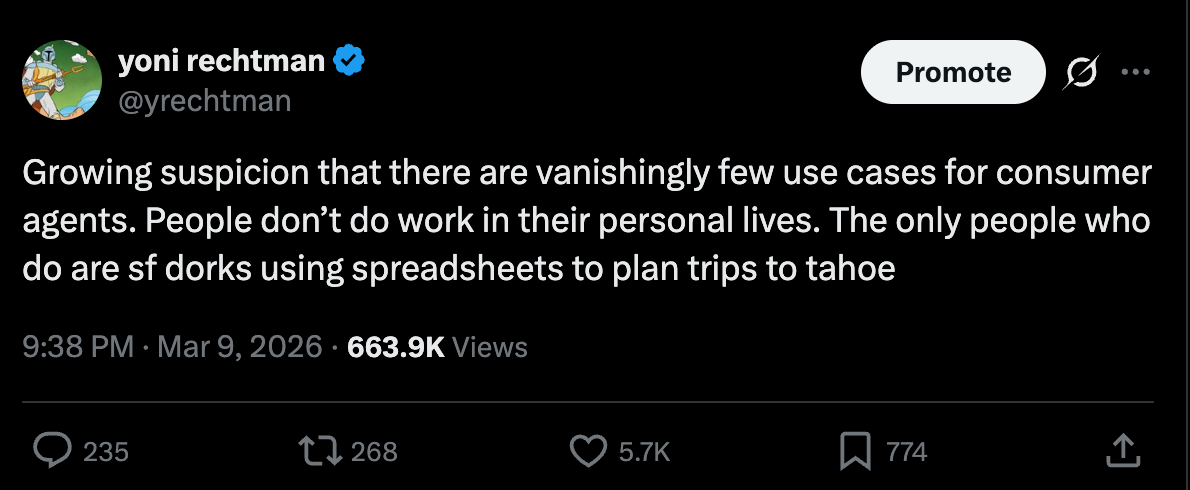
Here’s why I’m right, and here’s what’s at stake.
What an agent is, and where agents are useful
An agent takes action on your behalf where you are the principal. An app does not. We know what apps are. We’ve been using apps for a long time, and there are lots of good AI features that can make apps work a lot better, which is a far cry from saying that the AI will proactively organize your life for you...
There is a reasonable argument that by now ALL AI products are “agentics” or have “agentic” qualities/features: browsing the web, deciding what modality in which to respond to a prompt, etc. are all actions taken on behalf of users. But if every product with AI is an “agent,” it’s a meaningless term and the whole argument reduces down to “is AI useful” which it obviously is.
The important debate is what it’s useful for, and where it hits natural limits that have nothing to do with scaling laws or inference costs - at least short of physical AGI.
AI agents are nascent but the overall concept is not so new that we already know where they can/will be useful: the middle ground of complexity between purely rote tasks (can do, maybe not necessary) and highly effortful/intentional personal endeavors (can’t do).
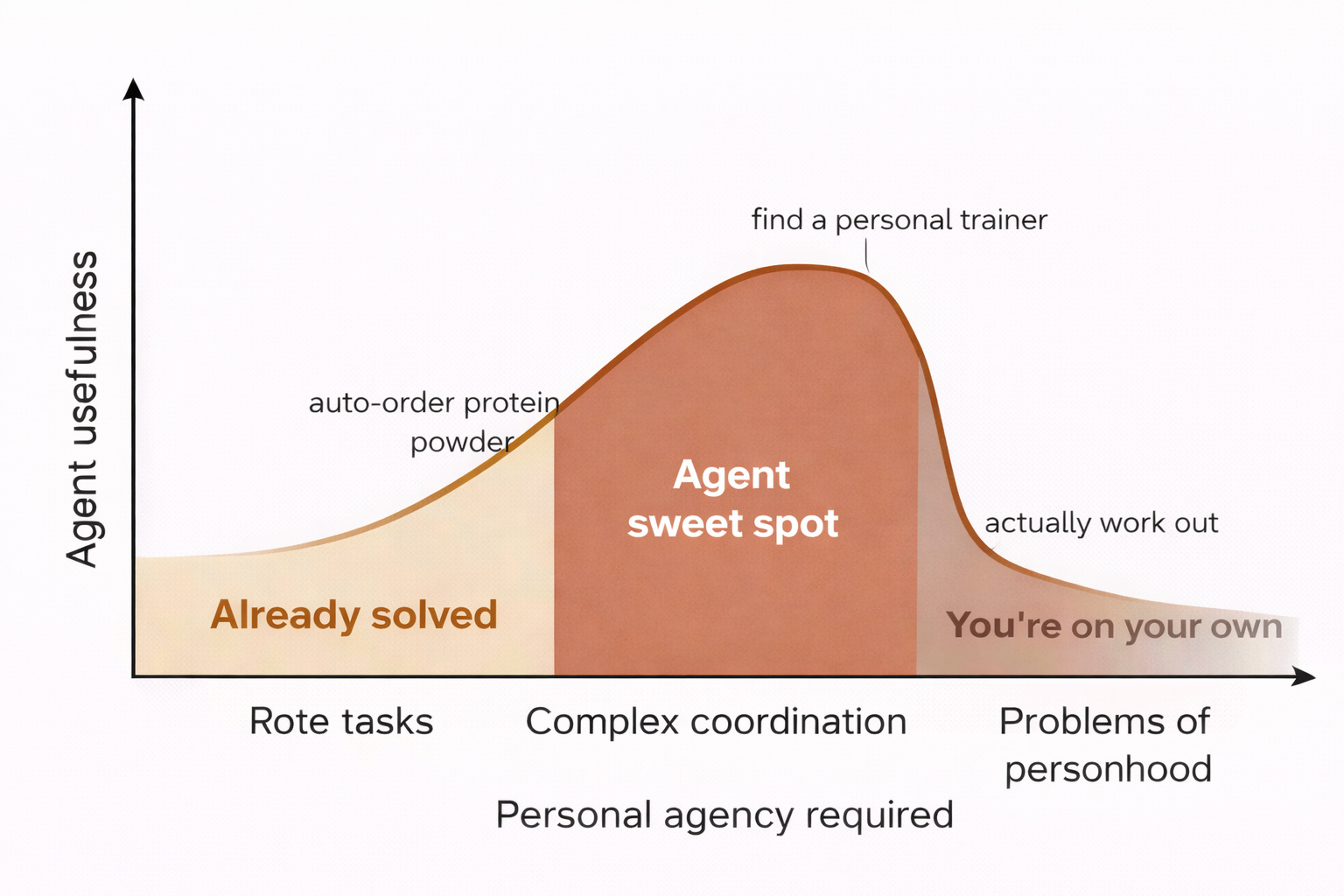
I totally believe that things that require a measure of coordination and memory are useful surface area for agents. That can include things in the real world. Finding service providers, doing your taxes, scheduling appointments: that’s the middle of the curve where an agent with sufficient context can probably make your life a little better around the margins.
But there are hard limits here. If it takes a little bit of agency you can make gains by handing off to an agent (price compare a bunch of stuff vs. buying the first result on Google). But if it takes a lot of agency (cleaning your apartment or reading a book) the agent is useless. Going to the gym with AI that helps plan a workout only matters if you get yourself to the gym and claiming that an AI that makes you a workout plan is “agentically getting you into shape” is just baby talk.
Things that require agency require YOUR agency to work.
Of course life contains work. Sometimes that’s a problem to solve but sometimes that’s just life. And when it is a problem to solve it may not be solvable by AI, let alone an agent specifically.
AI may be able to help you even if it’s not primarily an agent. AI features inside apps can be useful across the whole spectrum. The agent question is overly narrow and specific.
The confusion in the discourse is collapsing “AI is useful” into “agents are the future of consumer,” and those are completely different claims.
Real life doesn’t happen via command line
Of course people do work in their lives but most of it (the hard stuff) does not look anything like the work they do at work. Real life is rarely accessible via the command line.
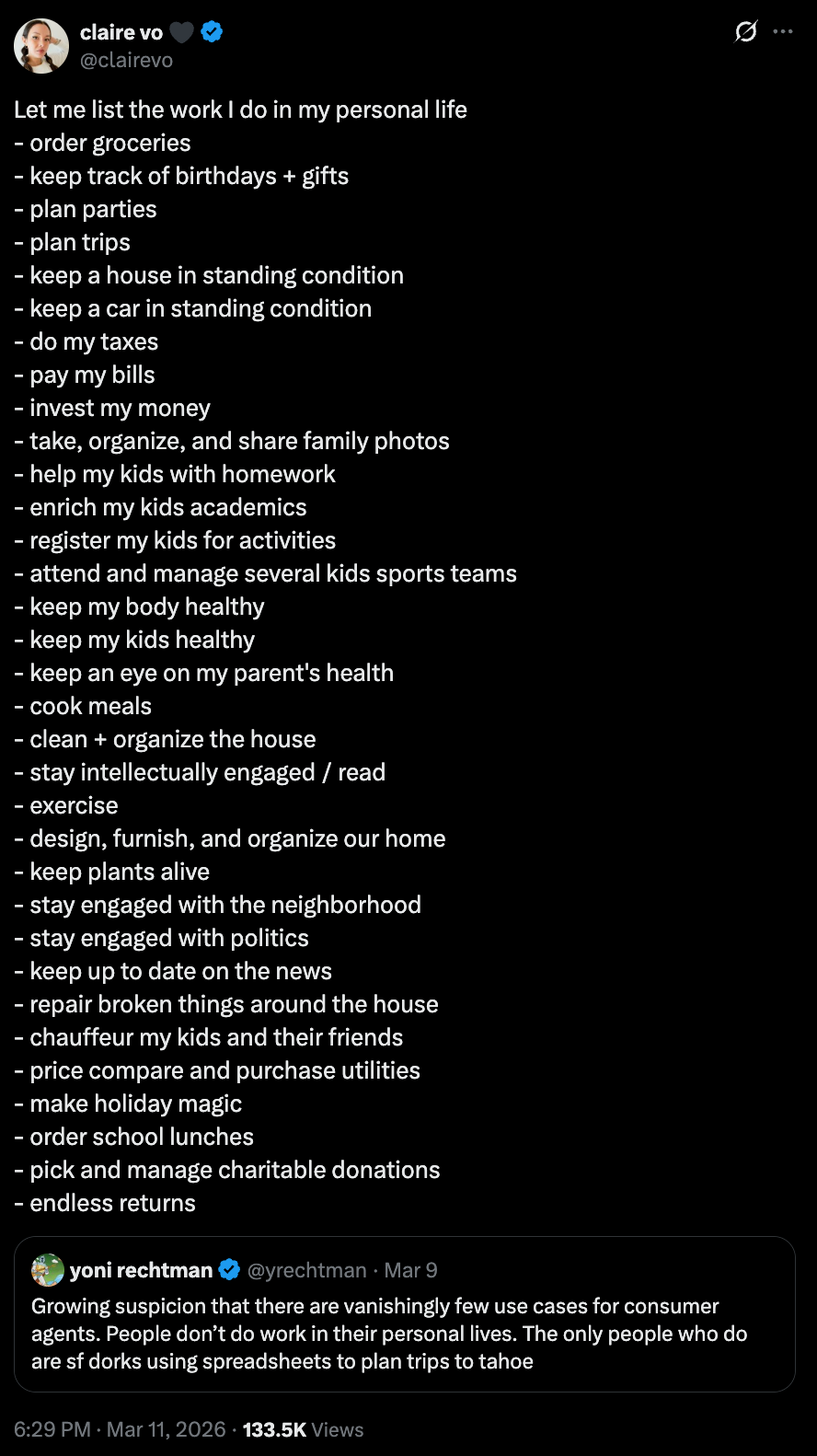
This list is... something. It mashes together completely different categories of life as though they’re all the same kind of problem.
Maxis hear “agents can’t do X” and get butthurt about “doomerism” ignoring that what you can do and what you should do are not 1:1. There are limits to each of possibility and desirability, largely unrelated to one another.
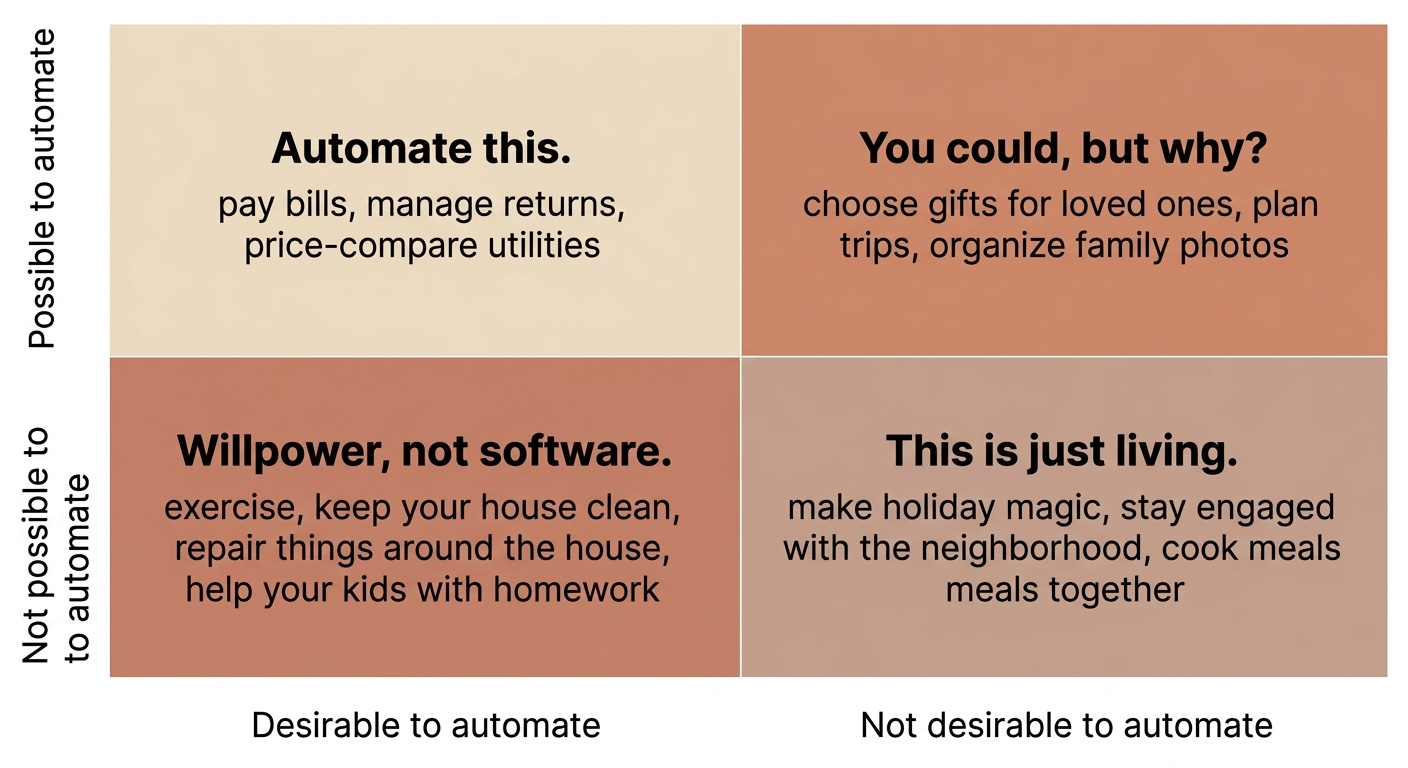
On desirability: you can already outsource gift-giving with a gift card, a corporate gifting program, or an assistant. But doing that misunderstands the rich culture and history of gift giving. To give a gift is to say something about yourself, the recipient, and your relationship together through an item. An agent-chosen gift is impersonal and cold like a gift card.
On possibility: there are problems that are just beyond the capability of agents because they’re not defined by coordination and memory at all. Sometimes they come down to skills and physical manipulation, where the coordination of that process is limited in its effectuation of the outcome.
An agent can find you a handyman, but it isn’t going to oversee that entire process: noticing the problem, explaining it aloud, clearing out the space so they can work, making time in your schedule, being home, opening the door, showing them where the problem is, answering their follow-up questions, pointing out the part they missed, noticing they scratched your floor, checking that it’s actually fixed, deciding you don’t like how it looks and asking them to redo it.
It will still take work from you to do a good job even if you outsource to a handyman via an agent. And the agent certainly can’t just fix the shelf itself.

And anyone who thinks agents will make parenting or running a household easier should read More Work For Mother.
What’s at stake
I will never bet against laziness. But outsourcing your social and emotional life to an agent is bloodless at best and demonic at worst.
Having a machine take over your life to smooth out all its inconveniences and to view all life’s friction as surface area to optimize is both profoundly bleak and wrongly technomaximalist. Claude cannot give you the will to change yourself. Not all struggle is suffering.
The only way to make agents work for most of that list is to profoundly change yourself to live for the AI instead of the other way around. We already do this in small ways (saying things aloud to ensure Granola hears it, etc). In darker terms it will mean avoiding paths inaccessible to the agents: only buying what can be delivered is an atomized, limited life.
I empathize with the optimization view. I often treat things that way and wish others would take care of things for me/that I could outsource every hassle. But it’s not something to be proud of.
Planning a trip together is an opportunity for connection and collaboration. We should strive for that even when it costs us convenience. The friction is part of the experience - sometimes a really valuable part.
The point isn’t asking what an agent can do (some stuff) or how useful AI is in general (very) or even what an agent is (who knows). The point is asking what is good and desirable: a life of rich connection where technology serves you and you exercise agency to be the person you want to become.
Thanks for Chris Melamed for reading and shaping.
Positive Sum HC
Most healthcare “innovation” is zero-sum at best, negative-sum at worst. I want more positive sum HC ideas
Basically every HC idea boils down to:
Pay providers more(drives up premiums, bad for patients)
Cover more care (drives up premiums, bad for patients)
Deny more care / pay less (bad for providers and patients)
Lots of shifting money around, very little to expand the pie. Much of this is just a reflection of the fact that “health insurance” isn’t really insurance; it’s catastrophic care insurance bundled with a rate card and a provider directory.
Prior auth automation/arms race is exemplary of the problem. You automate getting through hoops so payers build new hoops. Both sides spend more on admin despite the “efficiency.”
Positive-sum ideas I want to see/am rooting for:
Gold carding/eliminating prior auth entirely.
ICHRAs: an intermediate step to decoupling insurance and employment
AI for low-acuity care: 80% solution at 10% of the cost; improves outcomes per dollar vs “expanding access” which just increases volume/premiums
Care coordination: investment with a return on adherence lower readmissions
VBC: right in theory, but admin overhead recreates the disease and blocks out small providers
Pharma/new drugs: outside my purview but the purest positive-sum play. GLP-1s are the most important thing in the world after AI.
My personal blackpill: there are very few novel ideas for positive-sum systemic change in the biggest market in the biggest economy in the world.
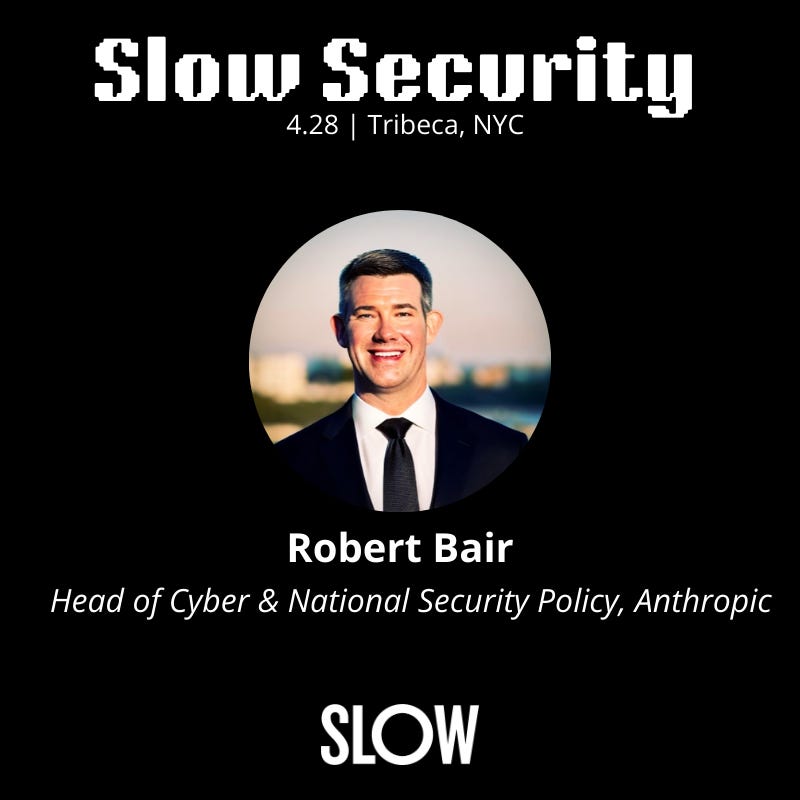
Slow Security
Super stoked for this: we’re hosting founders, operators, security leaders for a ≈100 person cyber security mini conference in NY next month
We’ll have Anthropic’s head cyber and NatSec policy for a fireside chat along with panels with people building and backing security companies. More to come soon.
Sign up to join us. Space is limited and we want to prioritize builders and buyers.
"Problems of Personhood" is a great phrase to explain the things AI won't be able to do. Love it.
This is the correct take btw