

The phone company always wins
Software margins are compressing. Network effects are still the best defense


Building network effects after agents
Software margins are compressing and pure application software is becoming a fundamentally different, worse category.
But network effects remain among the most reliable paths to durable software businesses. Switching costs are the real driver of pricing power and consequently margins and long term earnings. Network effects are one of the best ways to create them.
Aggregation is not a network effect
A lot of what people call “network effects” are actually aggregation advantages. Unless my experience gets better because you use the same system these are single player experiences without strong nfx. The value is just “we put all the options in one place.” That’s a feature an agent replicates trivially.
The Citrini note on DoorDash exemplifies the confusion, ”you’re hungry, you’re lazy, this is the app on your home screen.”If that’s all it is, then yes, agents destroy it. A vibe-coded delivery app can show you restaurants.
But merely surfacing all the restaurants in an area is not particularly hard with agents. Managing reputation, mediating disputes, routing and bundling orders across a network of drivers: all of these deliver value by having multiple parties transacting at once. More drivers makes routing better. More orders makes bundling possible. More transactions makes reputation meaningful.
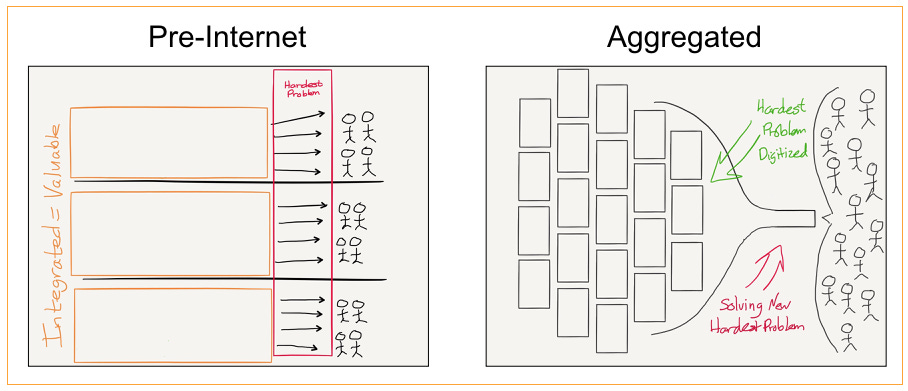
Finding and integrating suppliers is not the hardest problem anymore.
DoorDash is a sin eater enabled by multiplayer mode: it absorbs logistics risk, quality risk, labor coordination, etc. and quite literally handles the (long) first and last mile.
Agents commoditize aggregation, not network effects. Aggregation creates value. Network effects capture it. It’s easy to assume they go hand in hand because they usually showed up together. Agents break that coupling.
The OG network effects business (telecommunication) has no aggregation effects.
Where agents create new network effects
Agents don’t just leave existing network effects intact. They expand the surface area where network effects can form in three ways:
Networks of agents. Agents themselves become nodes in networks.
Agents as an on-ramp. Lower onboarding costs and easier participation.
Using aggregation to bootstrap nfx. Starting in single player mode and delivering demand side economies of scale later.
1. Networks of agents.
Agents themselves become nodes in networks. Not “agents help humans use networks better” but agents transacting with other agents, creating coordination layers that didn’t previously exist. When an agent representing a worker interacts with an agent representing an employer, or an agent representing a patient interacts with an agent representing an insurer, you get a new topology: a network where the participants are machines acting on behalf of people.
These networks get more valuable with density the same way human networks do. More agent-to-agent interactions means better matching, richer data, and higher quality outcomes. The difference is that agents can participate at volumes and speeds that humans never could, which means the network effects compound faster.
2. Agents as a new UI, expanding who can participate.
Some networks should exist but don’t because the interaction cost was too high for humans to bother with. The UI was too complex, the onboarding too heavy, the workflow too manual. Agents lower that cost to near zero, so dormant network effects activate.
People can interact with networks via agents instead of a UI. This means markets that were previously bottlenecked by complexity can now unlock participation. The surface area to build network-effective-driven businesses/products expands because you can onboard people invisibly.
3. Using aggregation to bootstrap your way to network effects.
Aggregation is getting easier to replicate. That makes it cheap, not useless. And cheap aggregation is a powerful bootstrapping mechanism for building real network effects.
You can brute force your way to a marketplace, kind of like DoorDash did with restaurants by calling in orders manually before restaurants signed up for the service. You start with an agent that delivers valuable single-player utility, and it backflips into a multiplayer network as a byproduct of individual agent actions. The single-player mode is genuinely useful on its own, and the network forms as a byproduct, not as a prerequisite. This solves the cold start problem that has killed marketplaces for decades.
Three Slow portfolio companies are each doing some version(s) of these: Phoebe in home care, Ando in hourly workforce, and Superdial in healthcare administration/payments. They’re building networks of agents, using agents to expand participation, and leveraging easy aggregation to bootstrap toward density and nfx.
I’m long network effects
Even as software gets squeezed on margins, network effects are still a reliable way to differentiate the commodity code and build durable, valuable software companies.
The generic conventional wisdom says “agents destroy moats.” The reality is more specific: agents destroy aggregation moats. True network effects, where the product improves with more participants, not only survive but become viable in more categories/modalities.
Citrini is wrong and intelligence will be a tailwind for NFX even as it wipes out commodity aggregation.
We’ll see more businesses building for network effects because there are both new surface areas (agents themselves as nodes in networks) and new modalities (UI-less network effects, invisible onboarding) and new GTM approaches (single-player-to-multiplayer backflips, cheap aggregation as a wedge into deeper network plays).
Read more:
Modeling software after SaaS: The software companies that succeed in this brave new world won’t be pure application software and they certainly won’t be traditional SaaS. But they will be bigger and throw off huge amounts of cash to their shareholders... at permanently lower margins.
Creating margins after SaaS: Software is definitely not dead. Nor is SaaS. But pure software will be a much different (worse) business than it is today.
Elsewhere
The 2026 Global Intelligence Crisis - Citadel Securities
Pretty remarkable to see this response, which is itself remarkable
Displacing white collar work would require orders of magnitude more compute intensity than the current level utilization. If automation expands rapidly, demand for compute definitionally rises, pushing up its marginal cost. If the marginal cost of compute rises above the marginal cost of human labor for certain tasks, substitution will not occur, creating a natural economic boundary. This dynamic contrasts sharply with narratives assuming frictionless replication of intelligence. Even if algorithms improve recursively, economic deployment remains bounded by physical capital, energy availability, regulatory approvals, and organizational change. Recursive capability does not imply recursive adoption
Remember, diffusion and implementation are massive tasks and huge opportunities. Evidently OpenAI agrees!
Are You “agentic enough?” - Wired
I talked to Max from Wired about the newly in-vogue/paradigmatic startup employee: multi-hyphenate, commercial generalists. Everyone wants high agency, AI native employees. The engineers want to talk to customers and the business people write code.
High agency and AI native instead of heads down 10x performers.
Abundance agenda 2.0
Against the backdrop of yesterday’s absolutely insane, fever dream Trump-Mamdani confab 2.0, Abundance NY is hosting a great event on Tuesday with the Wagner School.
This political moment needs policy ambition to match and ANY is continuing their great work to make it so.
Very helpful. I plug your posts into claude code with my strategy and it spits out great ideas. I have to beat claude a bit with a stick but then it's fantastic!
Strong agree on aggregation vs. network effects. The moat isn't the model — it's the transaction ledger.
Your cut is right, but there's a move that changes the math entirely: applied AI inside real operating businesses. Call it the intelligence buyout. Not "AI company with a services arm." A services business where AI is the operational substrate, and every customer interaction makes the next one cheaper, faster, sharper.
Long Lake, Crescendo, Eudia, Titan MSP — they look like operating companies because they are. But every resolved HOA dispute, every closed support ticket, every contract reviewed is a training event. The marginal cost of the next customer doesn't just fall. It falls *while the quality goes up*. That's the compounding loop nobody else can enter by writing a check.
Coordination costs collapsed once with the internet. Agent-to-agent automation drops them again. But the real network effect forms a layer below both: in the proprietary transaction history only a live operator accumulates. Capital can buy the call center tomorrow morning. Capital cannot buy what the call center's agents learned last Tuesday at 3am.
Agents talking to agents is a new topology. Agents talking to agents *on top of* a decade of real-world operational judgment is the phone company. You can't write a check for it. You have to earn it, one transaction at a time.