


Below is a lightly edited version of a section from the quarterly letter we sent to our limited partners last week.
Every general-purpose/horizontal technology charts a familiar course between early excitement and mature, scaled deployment. At first, euphoric money floods the zone to build the infrastructure and explore novel possibilities, creating paper wealth and paying for the buildout/installation.
Eventually every bubble burst (railways in 1847 and 1873, utilities in 1929, fiber in 2001, crypto in 2018) leaving behind critical infrastructure for a next generation of companies and investors to build newly possible companies.
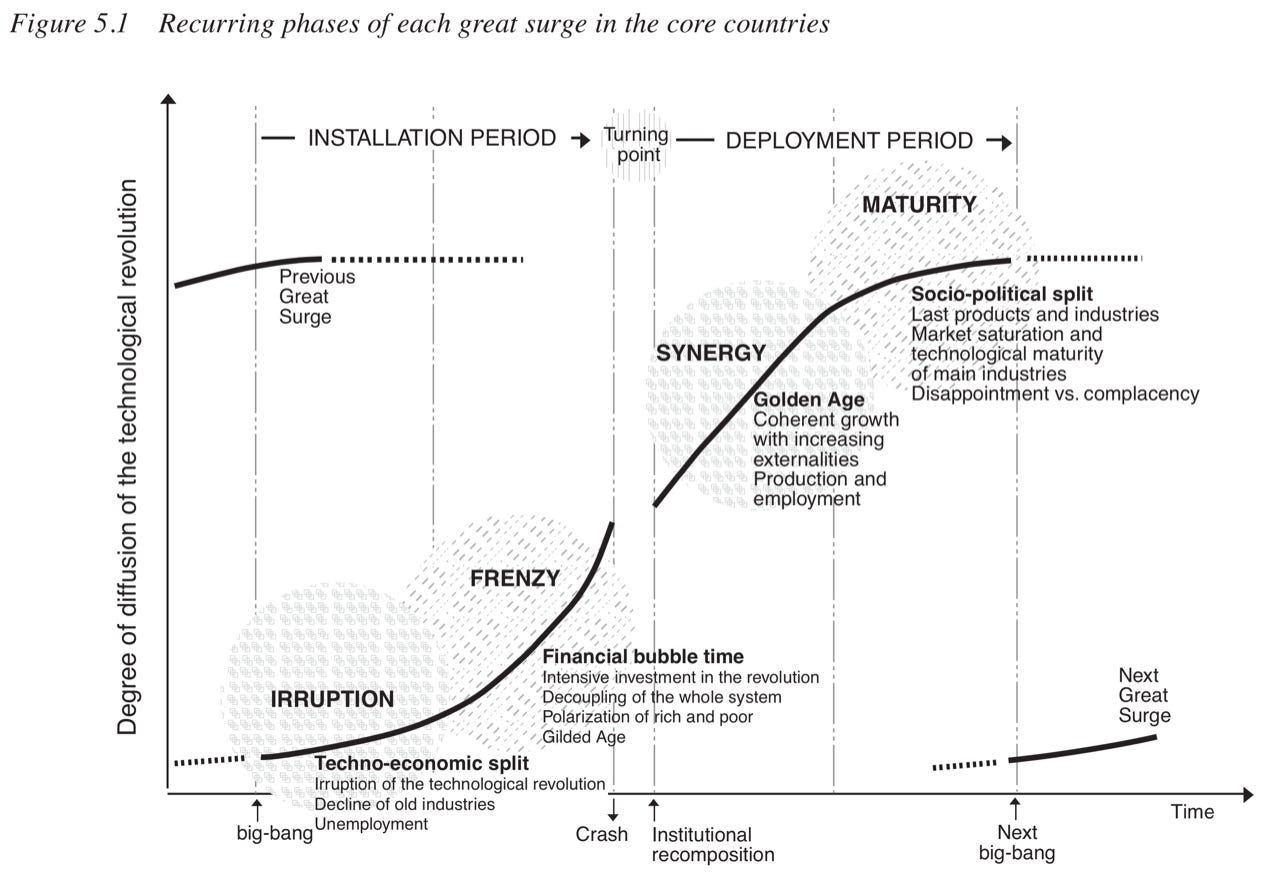
There is euphoria and mania on the way up, and a brutal hangover after an inevitable crash before the real work starts. Clearly we are in “The Frenzy” today.
The refrain is always “it’s different this time.” But what’s different specifically - the scale, the speed, the sophistication, that it’s finally coming for knowledge work? All in some sense true but orthogonal to the point of how businesses work and who “decides.” That is, each of those is a claim about the supply side (fast, cheap, high quality).
And value capture is not principally gated by the supply side (the vendors). It’s gated by the customer prerogative: how long it takes a hospital, a bank, a law firm, etc. to refactor around the new tool. A better model doesn’t buy you a faster customer because the binding constraint doesn’t move. The cycle of diffusion is slow, even if its onset is sudden.
We are long-term bulls. AI is going to break (is breaking) the economics of industries everyone assumed were untouchable. That is a big deal - obviously. Much of the market treats that as a sufficiently investable idea unto itself. It is not, at least not for us.
Accepting that the economics break doesn’t tell us enough about where to put the next dollar. The real questions come after.
Who is organized to rebuild the broken economics and win?
Where does the value sit long term?
Who can defend it once they’ve got it and what does it cost them to hold?
Everything short of answering those is a trade. Trades can make great money if you know when and how to get out. But that’s not our bag; we want to call the shot on what is durably valuable along the way and after.
Historically, the biggest long term winners have always been the consumers and users of a technology, not its developers:
Steel producers and oil majors vs cars
Internet service providers vs internet platforms
Electric utilities vs electrified industry
Datacenters vs AI, ironically
Consumer not vendor surplus is the historical norm. And given our hold period and presumption of illiquidity, the long view is all we have.
And it’s recursive: the market cap of steel today is a fraction of the market cap of planes and cars which is a fraction of the market cap of all the businesses made possible by planes and cars. Same for rare earths vs chips vs the computerized economy (functionally, global GDP).
So we want to back things that are newly possible using AI infrastructure, talent, and technology which also conform to our ideas about what makes a good business (terminal value).
Increasingly, we think/see/can prove that AI brings businesses closer to selling outcomes not workflow. The best businesses have always sold outcomes and now there’s more surface area to do that in big markets. That’s where we’re largely focused, across B2B and consumer, business models, and markets.
We are looking for the planes and the cars of AI (and the businesses relying on the planes and the cars) that conform to our basic rubrics for quality (durability, defensibility, and value prop).
To the users go the spoils.
Big Things Take Time
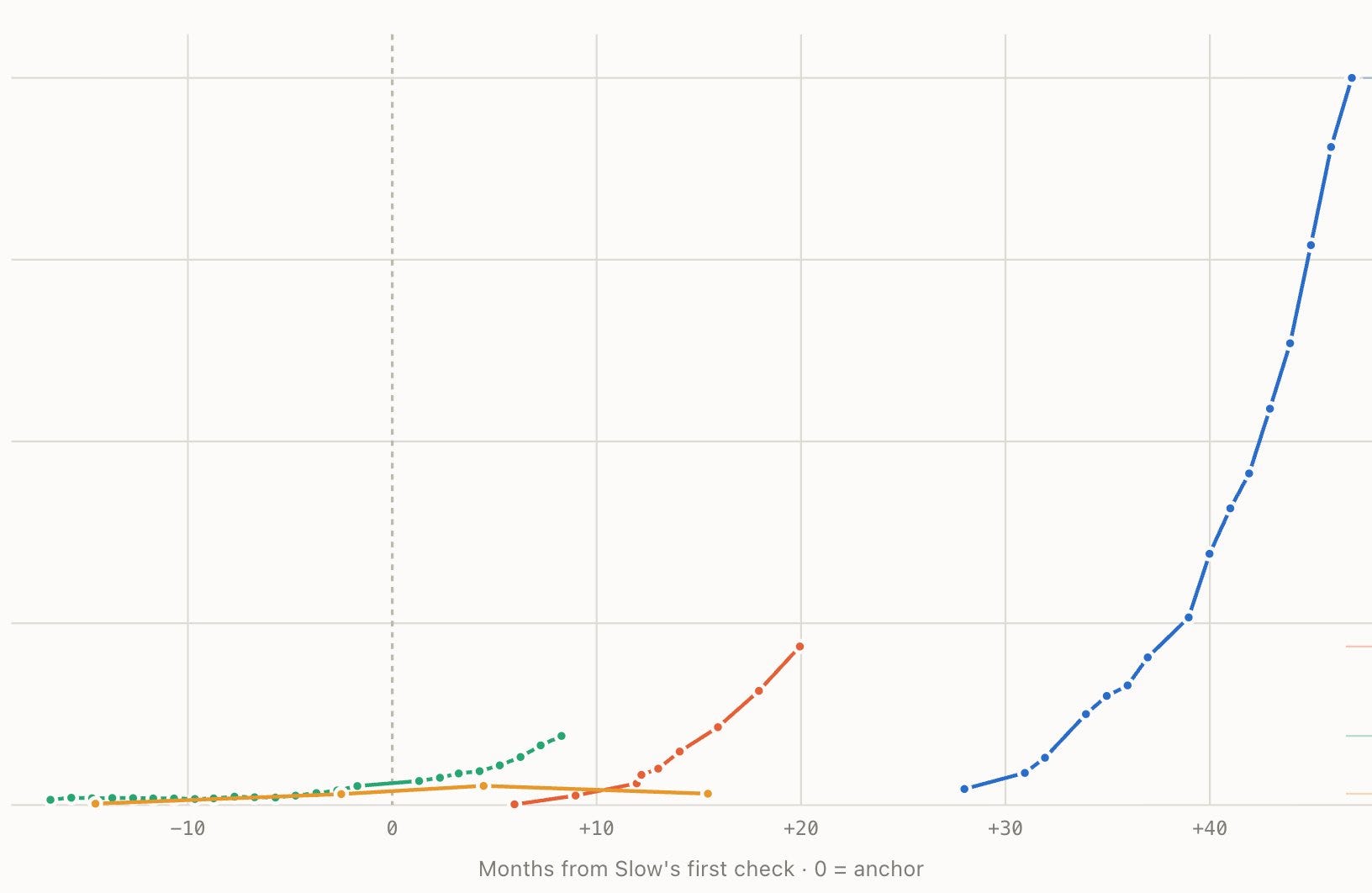
Consistent feature, kind of suprising, worth remembering: time to first revenue is rarely a meaningful predictor of future growth rates.
But once you get going you gotta really go!
Elsewhere
Valuing AI Harnesses - Tomasz Tunguz
It’s time to build software - Phin Barnes
Why would you ever invest in consumer at pre-seed? - Nathan Lee.
Nathan and I have been debating this for the last couple weeks. I’m not completely sold yet but he thinks he’s onto something.