

Post agent companies
Eyes on the end game



Editor’s note: This is a co-authored post with Justin Woodbridge, the founder and CEO of Phoebe. Phoebe is building a network of agents for healthcare labor. I mostly just added jokes. We’ll be back to our regularly schedule programming next week. Go Knicks.
White Noise
Everything feels astroturfed. Last week we were token-maxxing. Now we are token-minning. We are rolling up, we are buying out. We are taking private (funding secured), and everyone is monitoring the situation. Tech is in a DeLillo novel, with the hum of manufactured, short-lived narratives getting louder every week.
Underneath it all, everyone is trying to figure out where does this all end up? What is the end game?
Each big-bang moment gives new primitives, scrambling the core axioms around which the big winners are built. PCs gave us Apple and Microsoft, Web gave us Google and Amazon, Cloud gave us Salesforce, mobile gave us Uber. Each of these technologies came with new and unique assumptions for how to build a company for the moment; business model, GTM, and org structure are artifacts of each respective paradigm shift.
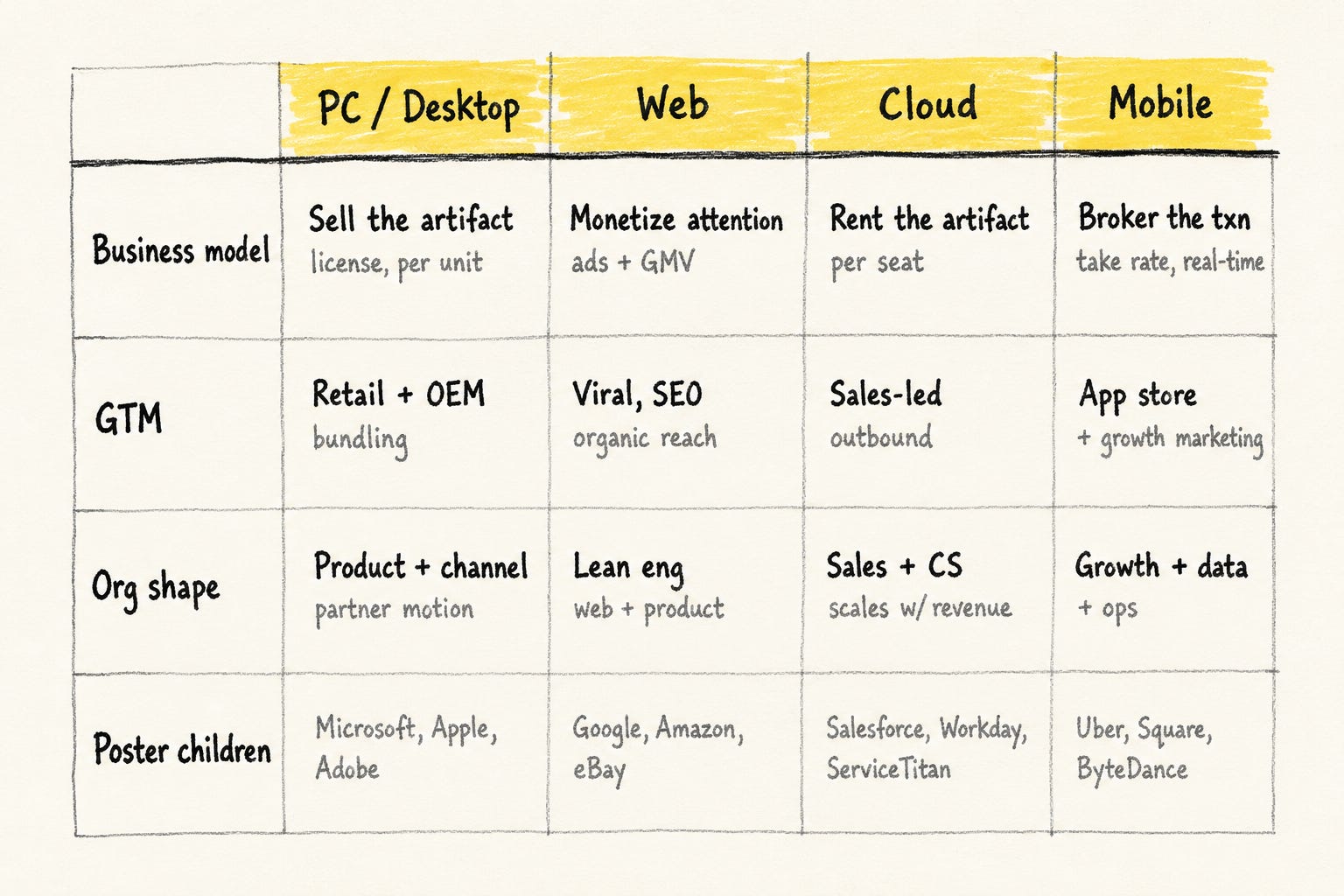
So what does the agent-shaped company look like? What is the new primitive, and what assumptions does it reset?
Vertical Market Genealogy
Historically, there have been two strategies for vertical tech companies: pure SaaS (sell the tool) and full-stack (build the tool, sell the work). This current cycle has seen the emergence and popularization of two AI-inflected archetypes built on that prior art:
Sell the tool as a “system of action”
AI and agents power tremendous experiences and value for customers. There is a great race underway to be first to serve them by localizing horizontal workflows for their needs.
These companies look like 2010s vertical software companies in their business models, GTMs, and teams/cultures. They bolt AI features onto stuck-in-the-mud SaaS thinking and are “AI native” only insofar as they were founded after the release of ChatGPT.
Do the work as a “neofirm” or “AI rollup”
These companies build agents to transform traditional operating businesses and own all the upside.
Doing the work as a neofirm or rollup (taking advantage of new intelligence) relies on commodities and does not produce the scarce resource: attention, context, and reach.
As models get cheaper and competition increases, what differentiates my agent from your agent, my firm from your firm? Without differentiation and decommodification, it’s all execution to eek out advantages; that’s not the end-game, nor the strategy to be the last-and-final mover.
The trillion dollar question: what is wave 3?
Infinite, free, on-demand cognitive labor as the new primitive
At the limit, agents represent a new building block: labor that is digital, directable, and deployable on-demand, and most importantly, free (eventually, through open source and local inference).
So the end game is not building more capabilities and applications for computers. Traditional software companies are built around assembling specific capabilities for computers, and profiting off the time and expense that it takes to do so (teaching computers what you wanted them to do was hard). Increasingly intelligent models compress all the capabilities out of the box.
The mid game trap is to get addicted to the human:agent arbitrage (sell agent labor at human prices). The end game to bet on cheaper, faster, local and open source models that make intelligence free.
The post-agent company will win this marshmallow test.
The defining post-agent company isn’t going to be horizontal, that’s for the labs. The most exciting question is not what kinds of apps and software tools can you build - it’s the new business strategies and models they enable.
Instead of “teaching computers,” the new opportunities revolve around “using computers;” - directing and deploying 24/7 intelligence to do more work (raw volume), cheaper work (cost), better work (quality), and the long-tail of tasks that never made economic sense to do before.
And the most promising places to do so are huge, fragmented, physical verticals like healthcare, logistics, and construction where fractious human labor is the critical input (not computer tasks).
Neofirms are the wrong strategy in these markets. You can’t simultaneously networkmax and controlmax. One must give way to the other as the p0, totemic belief (breadth vs depth). And control in real-world, coordinate-constrained businesses is a mirage; you are sending people you can’t observe, into locations you don’t own, to do work you can’t automate.
The post-agent business believes and embraces that software and cognitive/computer-based labor is going to zero. And so the post-agent business counter-positions its product, go-to-market, and strategy around that which is still scarce and valuable: context, attention, trust and brand to produce sustainably differentiated outcomes via network effects.
Stretch the New Primitive to Its Logical Conclusion
What happens when you do the work, but take it one step further and give away most-or-all of the rote/labor/replacement-level value?
Instead of building and selling software tools, you are building digital workers to do the work?
What if instead of trying to monetize the work, you commoditize the work?
The defining opportunity is one of newly unlocked business models, strategies, highly-potent, nascent go-to-market motions.
Business models
The post-agent company should be focused on as efficiently and swiftly as possible vacuuming up what is going to be scarce at the end-game: context, attention, trust and brand to produce sustainably differentiated outcomes via network effects.
These companies will be asset-light attention aggregators, coordination infrastructure, and trusted clearinghouses / agent-native marketplaces. (whether monetizing through transactions, advertising, attention routing)
GTM
The post-agent company flips the inevitable commodity-nature agents on their head and uses that as a sharp GTM strategy to penetrate quickly, efficiently, and expand from there.
Digital workers do the work and give it away to gather context, bootstrap flywheel and build network effects. The single player mode is instantly valuable enough to attract demand and jumpstart the process.
Team
The post agent company is deeply technical AND obsessively entrepreneurial at all levels and in all roles, transcending the iron triangle (and the “conjoined triangles of success”). To be a truly post-agent organization, a business will embrace agents in every part of its business, expecting every member to use these tools to ship and solve problems for customers.
When intelligence is an opex line, commercially minded, entrepreneurial individuals and teams will spin up teams/pods/agents/resources on demand unbound by classical thinking about empire building and headcount.
Give away the labor, capture the network that runs through it. When your competition is built around profit from software or services, how can they respond to you doing the work for free?
The post agent company orients itself around continued, rapid improvement in the cost and performance of underlying models and intelligence. It assumes, at every level, that the future does not merely look like the past but rather sees discontinuity and a true paradigm shift, just like what PC, web, cloud, and mobile ushered in.
Phoebe
We’re putting our time and money where our mouth is with Phoebe. Phoebe is building a network of agents for in-home healthcare, the largest AND fastest growing workforce in the country:
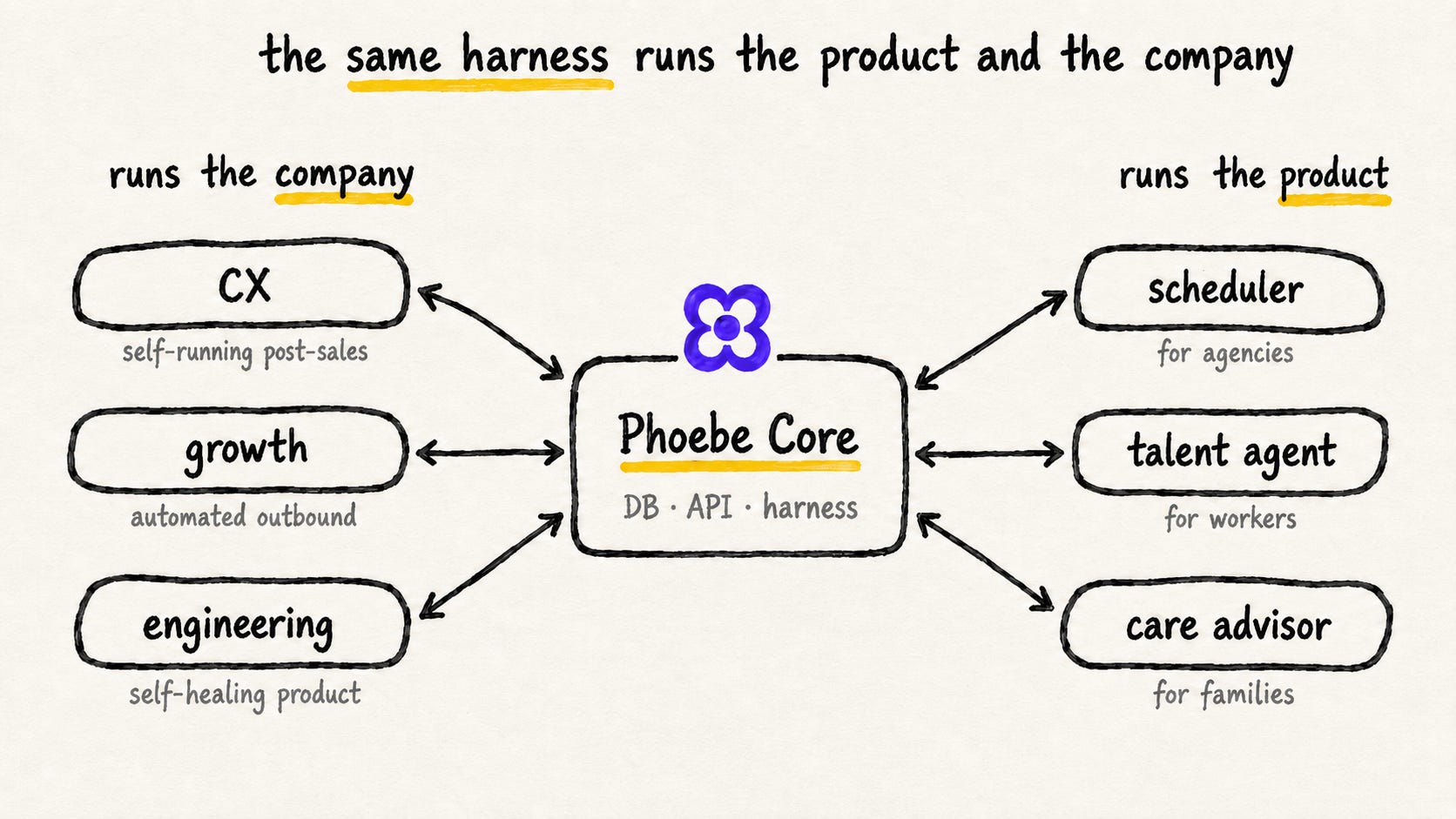
digital employees for agencies to manage schedules and run their business
talent agents for labor to make more money from better shifts
care advisors for families to get the care they need
Today, Phoebe the product and Phoebe the company (Recurrence, the maker of Phoebe) are one and the same. But our real product is the engine that designs, propagates, and manages the network of agents.
As a post-agent company, we aren’t just building external workers for our customers. We build internal workers to execute all the functions of the organization. That’s why we’re building the company first and foremost around engineering; 60% of the company has a CS degree and ⅓ of the company are former founders. Everyone ships.
Engineering and systems thinking is the means by which we build the machine that runs Phoebe. Engineering becomes the highest point of leverage and every function is engineering-assisted (our head of CX is our most active Devin user)
Phoebe’s culture in practical terms
Our company runs on a stack of internal agents and tools that revolve around a central database and API (Phoebe Core). Here we fold in the raw exhaust of every system of the company: each email and call (sales, post-sales, hiring), product metrics from Posthog, agent traces, GTM data, etc. Crucially, the same harness that runs our customer-facing product also powers these company agents.
Phoebe core is explicitly designed to be a vibe-coding safe zone and allow tooling to emerge bottom up, from every corner of the company:
In CX, Cindy and Dash built an increasingly-automatic post-sales CRM, with agents that run on schedules to monitor communication, check account health, usage metrics, and all the other core CX tasks
In Growth, Suket and Srini run outbound and paid increasingly through a variety of automatic systems that we won’t discuss further here (no alpha leaks).
In Engineering, our product is becoming increasingly self-healing. Our harness automatically reads and reviews its own work, looking for bugs and poor performance for customers. It’s aware of its own code, knows our customer base, and can search through all of Core (production logs, call transcripts, Posthog data), to fix bugs and gaps.
I also fundamentally believe in betting on deeply AI-native, junior talent with no prior assumptions on how businesses/products are built and no constraints on the problems they want to work on. We have early career engineers working in every org: sales, support, and of course engineering.
Skills mean very little now. Mindset, flexibility, and motivation mean everything. More than that, we look for people with Jeremy-Strong-levels of off putting, candorous love of the game. People that want to win, that are commercial minded, and treat business like the athletic game it is.
Phoebe is hungrily adding AI-native, AGI-pilled talent at every level and for every function to build toward the end game and live the real-world Factorio dream.
 | A guest post by
|