

Betting on vision
Cargoculting, coherence, and a vision for the future


We are on the precipice of a critical, multivariate, highly uncertain future driven by uncertainty in the path - development and deployment - of AI.
And one of the most exciting things about this moment is that there are so many viable, seemingly reasonable but deeply contradictory points of view about how it resolves.
Inference races to zero or stays expensive forever
Models keep getting better or they plateau
A multi-model world or consolidation to a few frontier labs
AI will take all the jobs or create all new jobs
There are any number of such scissor statements about AI, society, business in the air right now.
No matter what you do, you are making a bet on what the future/the steady state of the technology looks like. Any company you build has to be a reflection of that bet on the future expressed through every choice you make: your product, business model, and team/culture/org chart. It’s all one choice.
So “what do you think a valuable company looks like in the future” has to be the starting point for what kind of company you build toward and how you build it from 0.
That’s especially true for team and culture, which are upstream not just of what you can build but also how you can build it. They’re the necessary precursors to the product you build and the motion you execute.
There’s not true or absolutely path dependency. Talented people can obviously do all kinds of different things. But there is a relevant optimal path for the pieces as you’ve assembled them. Which pieces you assemble, and to what end, is hugely important and highly determining.
Last week I wrote about Phoebe and “post agent” companies with Justin, who has an extremely strong and explicit POV:
The post-agent business believes and embraces that software and cognitive/computer-based labor is going to zero. And so the post-agent business counter-positions its product, go-to-market, and strategy around that which is still scarce and valuable: context, attention, trust and brand to produce sustainably differentiated outcomes via network effects […]
Engineering and systems thinking is the means by which we build the machine that runs Phoebe. Engineering becomes the highest point of leverage and every function is engineering-assisted (our head of CX is our most active Devin user) […]
I also fundamentally believe in betting on deeply AI-native, junior talent with no prior assumptions on how businesses/products are built and no constraints on the problems they want to work on.
The point here isn’t whether his bet is correct (though I generally think may well be); it’s that a clearly articulated point of view necessarily drives every other choice for the business.
This matters more for startups than for anyone else because startups are deeply and persistently disadvantaged in almost everything; they have less/no money, access, team, or time. It’s hard for them to just say “we’re going to hire the best people or do things in the best way.” Instead, they need to find and exploit advantages, which means knowing where they are advantaged. It’s necessary to have a sense of who the best people are for you, rather than merely trying to get the best people in some generic sense. Here, local > global optima.
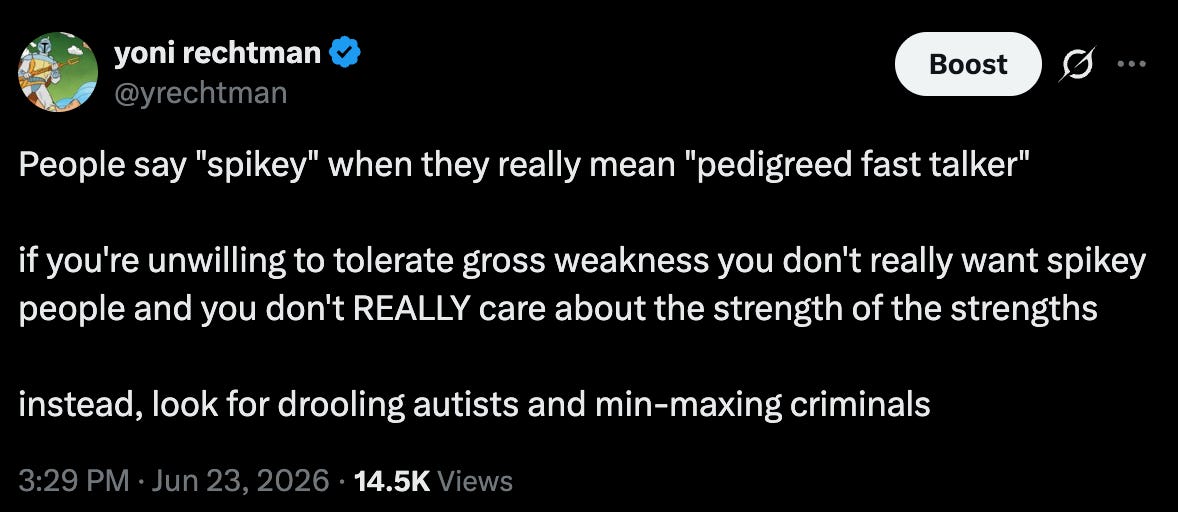
Almost everything in startups amounts to leverage and thrust-to-weight ratios. To hire spiky people requires having a sense of what trade-offs you are willing to accept.
There are two obvious ways to spot an inauthentic commitment to vision or a long term bet.
Cargo culting. Not necessarily internally incoherent, but assembled based on aesthetics and rote imitation. All signs and symbols. Think: “I want to look like Cursor, so I’m going to make choices that look like the choices Cursor makes” without understanding the thinking/bets behind them. This is the most common and the easiest to spot because it’s all external.
Incoherence. Your team doesn’t match the GTM, or your end state doesn’t match your roadmap. This is harder to spot, because it requires interrogating each/all.
These are both company killers. You have to make a bet in order to move quickly and decisively on all other choices.
Even claiming that you don’t have a point of view is still a perspective. It carries with it that the most important thing is to maintain optionality.
That’s a totally viable approach. Believing the future is highly uncertain, and wanting to preserve your options, has implications for how you build, just like going all in on one particular POV does. It is neither riskless nor riskier than anything else, except insofar as you don’t reflect it back to yourself through all the downstream choices you make.
But optionality is never free, you pay a premium to defer choices. You have to make a choice, and every choice is expensive, including the choice to preserve optionality and defer having an explicit point of view.
If anything, startups are advantaged here: they can afford to make choices that are irrational for other people, which lends itself to spiky choices and min-maxing. Optionality is one such advantage. Startups can hold it precisely because they have no infrastructure and no sunk costs to justify... at least for a time.
So it’s not style or “taste” but YOUR style that counts.
Choose wisely.
Programming note: I’m going on my honeymoon next week. This is my first non-laptop vacations in ≈10 years.😅 The newsletter will return in mid-July.
mazel tov!